Key takeaways
- Diesel theft is a major hidden cost for Indian fleets, often disguised as mileage variation or operational loss.
- Common theft methods include siphoning at dhabas, collusion at petrol pumps, and manipulating mileage records.
- Paper-based trip sheets and logbooks are not enough to prove or prevent sophisticated fuel theft.
- Advanced fuel monitoring systems with real-time sensors provide the only reliable data to detect and stop theft.
- Proactive alerts, such as automated voice calls to drivers, are more effective deterrents than passive SMS notifications.
Your biggest running cost has a leak
Your trip sheets never seem to match the fuel bills. A truck leaves your Chennai depot with a full tank, headed for Kolkata. It arrives on time, but the fuel gauge tells a different story. The driver blames heavy traffic on the highway, bad roads after the monsoon, or a struggling engine. You have heard all the excuses. But you know the real reason. Your profit is being siphoned away, litre by litre.
This is not a small leak. It is a large, organised problem that directly hurts your business. It is a hole in your accounts that grows with every trip. Relying only on a driver's honesty to protect your most expensive asset is a risky business strategy.
How much diesel is stolen from trucks in India?
There is no single government report that gives a precise figure for fuel theft. This is because most thefts are not reported. They are often recorded as 'mileage variations' or simple 'running costs'. However, experienced fleet owners know that a large part of their monthly fuel expense can disappear this way. For a medium-sized fleet, this loss can run into lakhs of rupees every year.
This is more than just a driver taking a few litres. It is a widespread issue that silently drains profits from Indian logistics companies. Telematics is the use of GPS and onboard diagnostics to monitor vehicles remotely. It provides the data needed to fight back. Our methodology involved reviewing transport safety data from the World Health Organization to understand the high-risk environment in which fuel theft occurs. This context is important, as road transport is a dangerous job where small crimes can easily be overlooked.
The common methods of fuel theft
To stop the leak, you must first understand where it is coming from. Theft happens in several ways, some more obvious than others. For instance, a driver might collude with a petrol pump attendant on a busy route like the NH44. They agree to bill for more fuel than was actually put in the tank and split the difference.
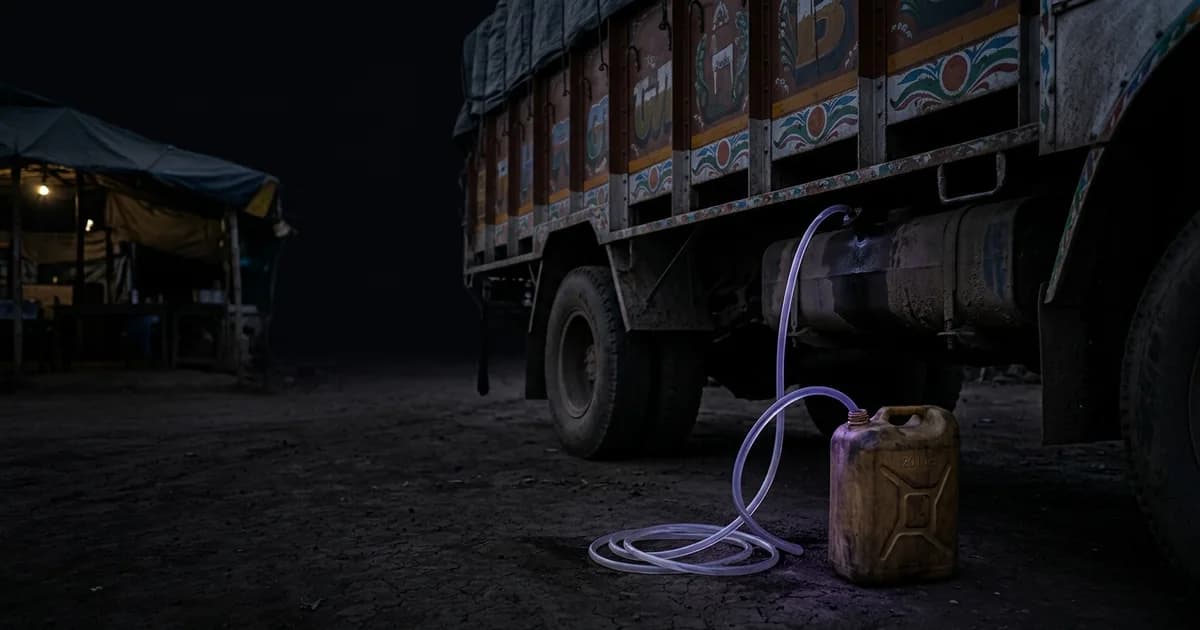
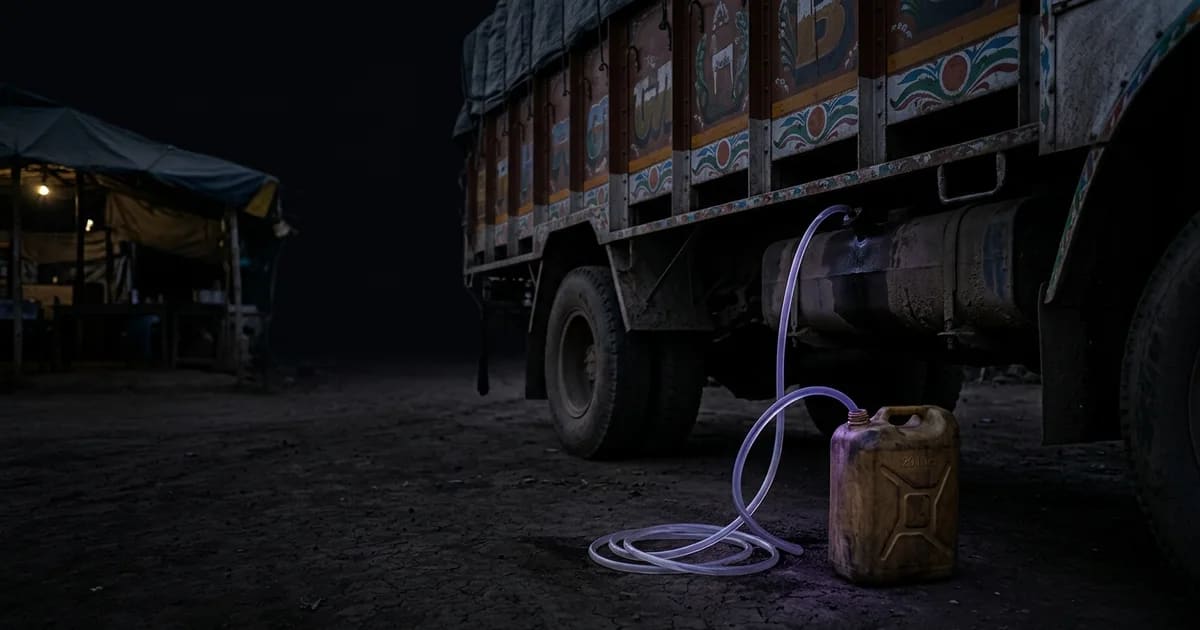
Fuel Siphoning is the act of draining diesel directly from a truck's fuel tank using a pipe. This is the most direct form of theft. It often happens when the truck is parked overnight or during long stops at roadside dhabas. Below are the most frequent ways your fuel disappears.
| Theft Method | Typical Location | Detection Clue |
|---|---|---|
| Siphoning | Highway dhabas, unsecured parking. | Sudden fuel level drop. |
| Short-filling | Petrol pumps. | Bill vs. actual fuel filled. |
| Mileage Fraud | Trip sheets, logbooks. | Low reported mileage. |
Where your diesel disappears
- The Dhaba Stop: This is the classic method. A driver stops for a meal. An accomplice uses a pipe to siphon 30 to 50 litres of diesel. The whole process takes less than ten minutes.
- Petrol Pump Collusion: The driver asks to fill up for ₹10,000. He gets a valid bill for this amount from a colluding pump attendant. However, the attendant only dispenses fuel worth ₹9,000. They split the extra ₹1,000 cash.
- Mileage Fraud: The driver reports a lower mileage figure than the truck actually achieved. For example, he might claim the truck gave 3 km/litre on a trip when it really gave 3.5 km/litre. He then keeps the fuel allowance for the difference. This is very hard to disprove with paper logs alone.
- Direct Sales: On long routes, some drivers sell diesel directly from their tanks to illegal roadside buyers. These buyers then sell it to local businesses or smaller commercial vehicles at a discount.
Why paper logs and manual checks fail
You cannot manage a problem that you do not measure accurately. Your trip sheets are often based on guesswork. A driver's word is not reliable when money is involved. The only way to answer the question of 'how much diesel is stolen from trucks in India' for your fleet is with real data. You need proof that cannot be argued with.
Manual checks, such as using a dipstick before and after a trip, are not practical for large fleets. They are also easy to cheat. For instance, a driver can manipulate the numbers or claim fuel was wasted in a traffic jam. Without technology, you are always one step behind. Compliance paperwork, such as that required by the eWay Bill portal, tracks goods, not fuel use. This leaves a major gap in your operational control.
AIS-140 is a standard mandated by the Indian government for vehicle tracking systems. It ensures that GPS devices meet certain quality and safety norms, as specified by the Automotive Research Association of India (ARAI). While a compliant GPS tracker is necessary, it only tells you the truck's location. It does not monitor the fuel tank.
The technology that provides undeniable proof
This is where modern technology provides a clear solution. An advanced fuel monitoring system uses high-precision sensors. These sensors give you a live reading of the fuel level in the tank. You can see every refill, every drop in level during transit, and every siphoning event in real time. For example, you might see a sudden 40-litre drop at 2 AM near a remote dhaba in Rajasthan. You get an instant alert on your phone. You now have proof.
This data changes the conversation with your driver. It moves from accusation and denial to a discussion based on facts. It is what separates a basic dot on a map from the best fleet management software in India. It is about getting data you can act on to protect your profits. Tracking fines and challans through portals like eChallan is important for compliance, but preventing fuel theft directly impacts your bottom line every single day.
The MoboSafe advantage: Proactive control
Getting an SMS alert about a possible theft is a good first step. But who is awake to see that alert at 3 AM? At MoboSafe, we designed our platform for the real-world challenges of Indian transport, governed by policies from the Ministry of Road Transport and Highways.
Here is what makes our approach different:
- Works With Your Old GPS: Our platform is hardware-agnostic. This means you do not need to buy all new devices. We can often pull data from your existing GPS units, saving you a large upfront cost. We add our smart software layer on top of your current setup.
- AI Voice Calling Agent: This is our unique feature. When our system detects a likely theft, it does not just send a quiet message. Our AI agent calls the driver or fleet manager. It speaks in their chosen language. The call might say, "Your truck has had a sudden fuel drop of 50 litres. Please confirm your status." This immediate, human-like call is a powerful way to stop theft in its tracks.
- Guaranteed Data Sovereignty: Data Sovereignty is the concept that information is subject to the laws of the country in which it is located. Our software is built in India, for India. Your fleet's private operational data is stored on servers inside India. With MoboSafe, you get world-class technology without risking your data's security.
Stop accepting fuel theft as a normal cost of doing business. It is a solvable problem. You just need the right partner to give you the proof and control to stop it.
If you have questions about how our system can integrate with your fleet, please contact us. You can learn more about our company and our mission on our about page. We are here to help you protect your profits.
Reviewed by the MoboSafe editorial team.
Tags
Written by
MoboSafe Expert Team
Logistics Technology Specialist
Contributing writer at MoboSafe.